

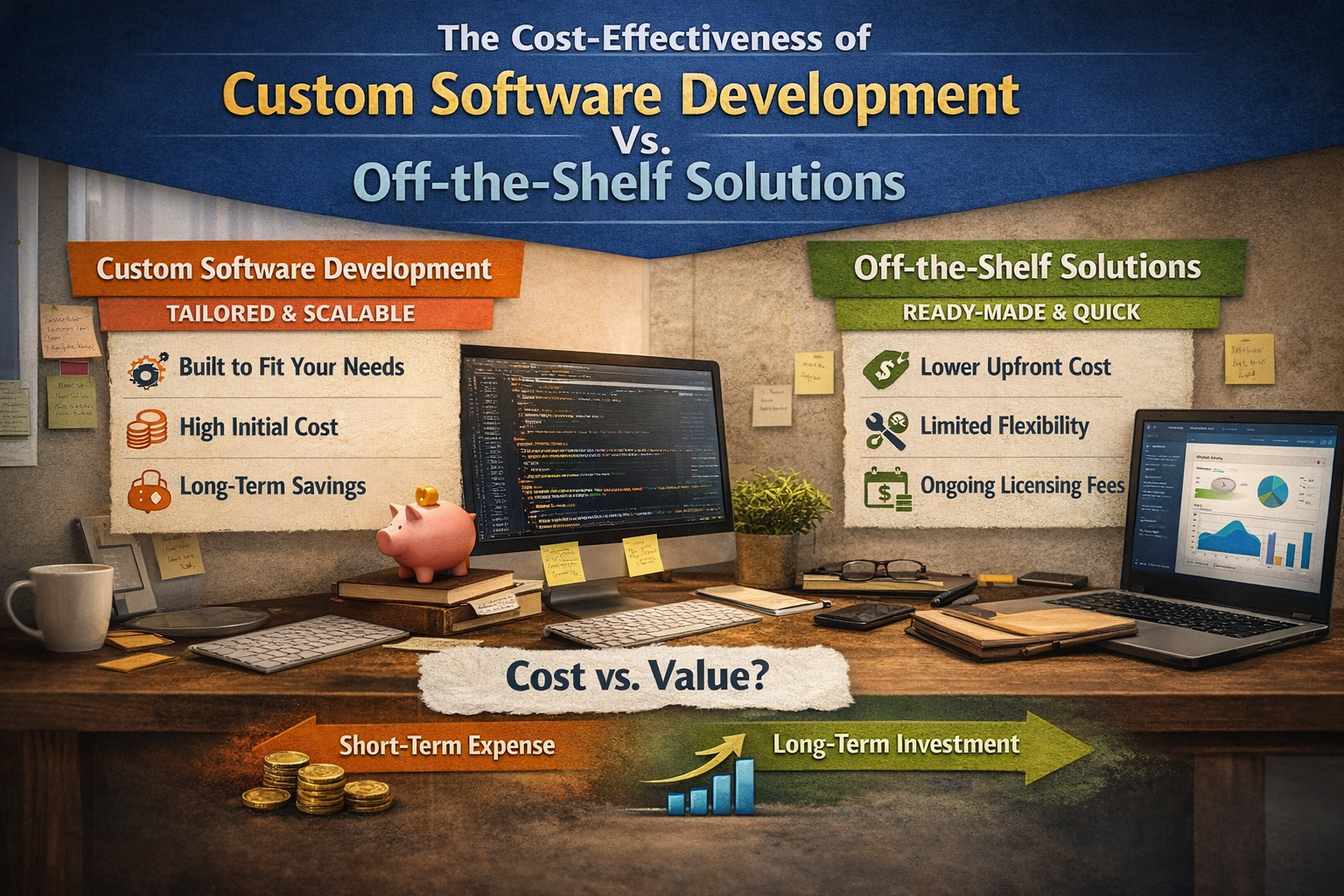
Making the right choice between custom software and off-the-shelf solutions depends on your business needs and budget. Custom software is tailored, scalable, and can save money long-term, while off-the-shelf options are quicker to deploy and cheaper upfront. Evaluate total costs, future growth, and unique requirements to decide which option is most cost-effective for your business.
At Developers Troop, we talk to founders and managers every day who are trying to navigate this exact dilemma. On one hand, you have the immediate gratification of a subscription-based tool. On the other, you have the long-term promise of a platform built specifically for your unique workflow. It’s rarely a simple choice, and the price tag you see on day one is almost never the actual amount you will end up spending over the next five years.
We believe that the “buy vs. build” debate shouldn’t be about which one is cheaper in the short term. Instead, it should be about which one drives the most value for your specific organization. Software is no longer just a utility like electricity, rather it’s the engine that powers your operations, customer service, and growth.
Choosing the wrong engine can stall your progress for years. That’s exactly why we’ve come up with this comprehensive guide to help you make the right decision. We’ll break down the true cost-effectiveness of custom software development compared to off-the-shelf solutions so you can make an informed decision for your company’s future.
What is Custom Software Development?
Custom software development is the process of designing, building, and maintaining applications that are tailored to a specific set of users or a unique business process. Think of it like a tailor-made suit. Every stitch is placed with your specific measurements in mind. We build these systems from the ground up to address the exact pain points your team faces every day.
Because you own the code, custom software is a proprietary asset. It doesn’t come with the limitations of a third-party provider. You decide when to add features, how the data is stored, and which other tools it connects to. While it requires a higher initial investment, the goal is to create a perfect fit that allows your business to operate at maximum efficiency without fighting against the software’s built-in constraints.
What are Off-the-Shelf Software Solutions?
Off-the-shelf software refers to pre-packaged applications designed for a broad audience. These are products like Microsoft 365, Salesforce, or QuickBooks. They’re built to solve common problems that millions of businesses share, such as accounting, email, or general customer relationship management (CRM).
These solutions are typically sold as a “Software as a Service” (SaaS) model. You pay a monthly or annual subscription fee to use the platform, and the provider handles all the updates and hosting. While these tools are incredibly powerful and easy to start using, they are designed for the “average” user. This means you often have to change your business processes to fit the way the software works, rather than the other way around.
Why Should Businesses Compare Costs Before Choosing Software?
If you only look at the initial invoice, off-the-shelf software will almost always look like the winner. However, we have seen businesses get trapped in “subscription creep,” where the cost of adding users and premium features eventually exceeds the price of a custom build. Comparing costs isn’t just about the purchase price; it is about the Total Cost of Ownership (TCO).
A thorough cost comparison helps you avoid the “sunk cost fallacy,” where you continue to pay for a tool that doesn’t work simply because you’ve already spent so much time and money setting it up. By analyzing the long-term expenses, you can determine if a custom solution will pay for itself through increased productivity or if a ready-made tool is more than enough for your current stage of growth.
Key Differences Between Custom and Off-the-Shelf Software
1. Customization and Flexibility
The most obvious difference is how much control you have. With a custom build, the sky is the limit. If your business model shifts, we can pivot the software to match. Off-the-shelf tools have “rigid boundaries.” You can customize some settings, but you cannot change the core logic of the program.
2. Implementation Time and Deployment
Off-the-shelf software wins the speed race every time. You can sign up and start using most SaaS products in minutes. Custom software, however, is a journey. It takes months of planning, coding, and testing to get it right. If you have an immediate emergency, a pre-packaged tool is your best bet. If you are planning for the next decade, the wait for a custom build is usually worth it.
3. Scalability and Future-Proofing
As your business grows, your software needs to grow with you. Many off-the-shelf platforms charge “per user” or “per record.” This means your software bill gets more expensive as you become more successful. Custom software scales without those extra fees. You can add a thousand new users without paying a dime more in licensing costs.
4. Integration with Existing Systems
Most businesses use a variety of tools like Slack, Shopify, or specialized ERP systems. Making these tools “talk” to each other can be a nightmare with off-the-shelf software if the provider hasn’t built a specific integration. With custom development, we build the connections (APIs) ourselves to ensure your data flows perfectly between every part of your business.
Cost Analysis: Custom vs. Off-the-Shelf
Upfront Costs and Licensing Fees
The initial cost is where these two options differ most. Custom software requires a significant down payment to cover the hours of engineering, design, and project management. Off-the-shelf software usually has a low entry fee, often just a few hundred dollars per month. However, those monthly fees are permanent. Over five or ten years, that “low cost” can add up to a staggering amount of money.
Maintenance and Support Expenses
All software needs care. With off-the-shelf tools, maintenance is included in your subscription. You don’t have to worry about server updates or bug fixes. With custom software, you are responsible for maintenance. This is an ongoing cost you must budget for, though it gives you the peace of mind that your specific bugs will be fixed on your timeline, not a massive corporation’s timeline.
Hidden Costs: Upgrades, Training, and Downtime
This is where many businesses get blindsided. Off-the-shelf software often hides costs in “add-ons.” You might find that the basic version doesn’t include the one feature you actually need, forcing you to upgrade to a “Pro” or “Enterprise” tier that is five times the price. Additionally, if an off-the-shelf provider has a service outage, your business stops, and you have no way to fix it yourself.
Long-Term ROI (Return on Investment)
We look at ROI as the amount of time or money the software saves your team. Custom software often has a higher ROI because it removes the “manual workarounds” your team has to do when using a generic tool. If your custom app saves 10 employees two hours of work every week, that is 1,000 hours of saved labor a year. When you do the math, the software often pays for itself within the first 18 to 24 months.
Advantages of Custom Software
1. Tailored to Specific Business Needs
When we build custom software, we start by looking at your whiteboard, not our existing templates. Every feature is there because you need it, and no feature is there to get in your way. This level of precision leads to much higher adoption rates among your staff because the tool actually makes their jobs easier.
2. Better Security and Compliance
For businesses in industries like healthcare or finance, security isn’t optional. Regulations like HIPAA or GDPR require strict data handling. While major SaaS providers are generally secure, they are also “big targets” for hackers. A custom solution allows you to implement specific security protocols that meet your exact compliance needs, often making it a safer harbor for sensitive data.
3. Competitive Advantage Through Unique Features
If you and all your competitors are using the same off-the-shelf CRM, you all have the same capabilities. Custom software allows you to offer something they can’t. Whether it is a unique customer portal or a faster way to process orders, having a proprietary tool gives you a “moat” that others cannot easily cross.
4. Cost Efficiency Over the Long Run
As we mentioned before, the lack of licensing fees is a massive long-term advantage. Once the development is paid for, your ongoing costs are limited to hosting and occasional updates. For a growing company, this is far more cost-effective than a subscription model that penalizes you for growing your team.
The Key Advantages of Off-the-Shelf Software
1. Quick Deployment and Accessibility
If you need to start tracking sales today, you can sign up for HubSpot or Pipedrive and be running by lunch. For startups or businesses testing a new idea, this speed is invaluable. It allows you to move fast and break things without a heavy financial commitment.
2. Lower Initial Costs
Not every business has the capital sitting around to fund a custom build. Off-the-shelf software allows you to access world-class technology for a fraction of the build cost. This “democratizes” technology, giving small businesses the same tools that the giants use.
3. Established Support and Community
When you buy a popular tool, you aren’t just getting the code; you are getting a massive community of users. If you have a question, there is probably a YouTube tutorial or a Quora forum post that answers it. Most major providers also offer 24/7 support, which is a luxury that is expensive to replicate with a small custom development team.
4. Predictable Performance and Reliability
Major software companies spend millions of dollars on testing. When you buy their product, you can be fairly certain it will work as advertised. The “bugs” have already been found and fixed by the millions of users who came before you.
Common Misconceptions About Cost-Effectiveness
Myth #1: “Off-the-Shelf is Always Cheaper”
This is the biggest myth we encounter. In our experience, SaaS costs tend to balloon over time. Between “user seats,” “data storage limits,” and “API call fees,” businesses often find themselves paying much more than they ever anticipated. Over a five-year window, custom software is often the more affordable choice for mid-sized companies.
Myth #2: “Custom Software is Only for Large Enterprises”
While it’s true that big corporations love custom tools, many small to mid-sized businesses (SMBs) use them too. If a small business has a very specific, high-value workflow that generic software can’t handle, a small custom app can be a game-changer. It’s about the complexity of the problem, not the size of the company.
Myth #3: “Hidden Costs Are Negligible”
People often forget about the “cost of training.” If your team finds an off-the-shelf tool confusing, they will waste hours every week trying to figure it out. Or worse, they will stop using it entirely. Custom software is built for your team’s specific logic, which often reduces training time and increases efficiency.
How to Decide What’s More Cost-Effective for Your Business?
Assessing Business Requirements
Start by listing your “must-have” features. If an off-the-shelf tool covers 90% of them, go with that. If it only covers 60%, and the remaining 40% are critical to your success, you are a prime candidate for custom development. Don’t settle for a tool that forces you to compromise on your core value proposition.
Calculating Total Cost of Ownership (TCO)
We recommend sitting down and doing a “five-year projection.” Calculate the subscription fees, the cost of the “Enterprise” tier you will eventually need, and the estimated cost of the manual workarounds your team will have to do. Then, compare that to the quote for a custom build plus maintenance. The numbers usually tell a very clear story.
Evaluating Scalability and Future Needs
Ask yourself where you want to be in three years. If you plan to double your staff, will your SaaS bill double as well? If you plan to enter a new market, will your current software support it? Thinking ahead prevents you from outgrowing your software and having to go through a painful migration later.
Case Studies or Real-Life Examples
Look for businesses like yours. We often share stories of clients who spent years struggling with generic tools before switching to a custom platform that finally allowed them to scale. Seeing how others have navigated this choice can give you the confidence to move forward.
When Custom Software Is Worth the Investment?
1. Businesses With Unique Processes
If your business does something that no one else does, you won’t find a software package for it. This is especially true in niche manufacturing, specialized logistics, or innovative fintech startups. When your process is your “secret sauce,” you need software that protects it.
2. Companies Seeking Long-Term Savings
If you have a stable business and a large team, the “per-user” licensing fees are likely your biggest tech expense. Building your own tool is a strategic move to eliminate those fees forever. It turns an “operating expense” into a “capital asset.”
3. Organizations Prioritizing Security and Compliance
If a data breach could put you out of business, you want full control over your security stack. Custom software allows you to build a “fortress” around your data that is tailored to your specific risks and regulatory environment.
When Off-the-Shelf Solutions Make Sense?
1. Startups and Small Businesses
When you are just starting out, your biggest enemy is time. You need to validate your business model as quickly as possible. Off-the-shelf tools allow you to get up and running without a major financial risk. You can always build custom software later once you have “product-market fit.”
2. Short-Term Projects
If you only need a tool for a six-month project, building something custom would be a waste of resources. Use what is already out there, finish the project, and cancel the subscription.
3. Businesses With Standardized Needs
If you just need a tool for basic accounting or internal email, don’t reinvent the wheel. The existing tools for these tasks are world-class and very affordable. Focus your custom development efforts on the parts of your business that are actually unique.
Wrapping Up
Deciding between custom and off-the-shelf software is a balancing act between short-term cost and long-term value. While off-the-shelf solutions offer a quick and easy start, custom software provides the flexibility, ownership, and scalability that can drive a business to new heights. We have seen time and again that the most successful companies are the ones that view their software as a strategic investment rather than just a monthly bill.
Making an informed choice requires looking past the marketing slogans and digging into the actual needs of your team. Whether you choose to buy or build, the goal should be a tool that empowers your people rather than restricting them. At Developers Troop, we believe in building technology that fits your business like a glove, helping you eliminate friction and focus on what you do best.
Ready to see how a custom solution can transform your operations and save you money in the long run? We can help businesses build high-performance, tailored software that eliminates licensing fees and boosts productivity. Contact us today and let us help you run a Total Cost of Ownership analysis for your next project.
Frequently Asked Questions (FAQs)
1. Is custom software always more expensive than off-the-shelf?
In the first year, almost always. However, over a five-year period, custom software is often significantly cheaper because it eliminates the per-user licensing fees that cause SaaS costs to skyrocket as your company grows.
2. Can small businesses afford custom software?
Yes. We often work with small businesses to build “Minimum Viable Products” (MVPs) that solve their most critical problem first. This allows them to get the benefits of custom software without the price tag of a massive enterprise system.
3. How long does it take to implement custom software?
It depends on the complexity, but most custom projects take between three to nine months from the initial design to the full launch. We break the process into smaller phases so you can start seeing value as quickly as possible.
4. What are the hidden costs of off-the-shelf software?
The most common hidden costs are “feature gated” upgrades, where you have to pay for a much more expensive tier to get one specific tool. Other costs include the time your team spends on manual workarounds for things the software can’t do and the fees associated with integrating the tool with your other systems.