


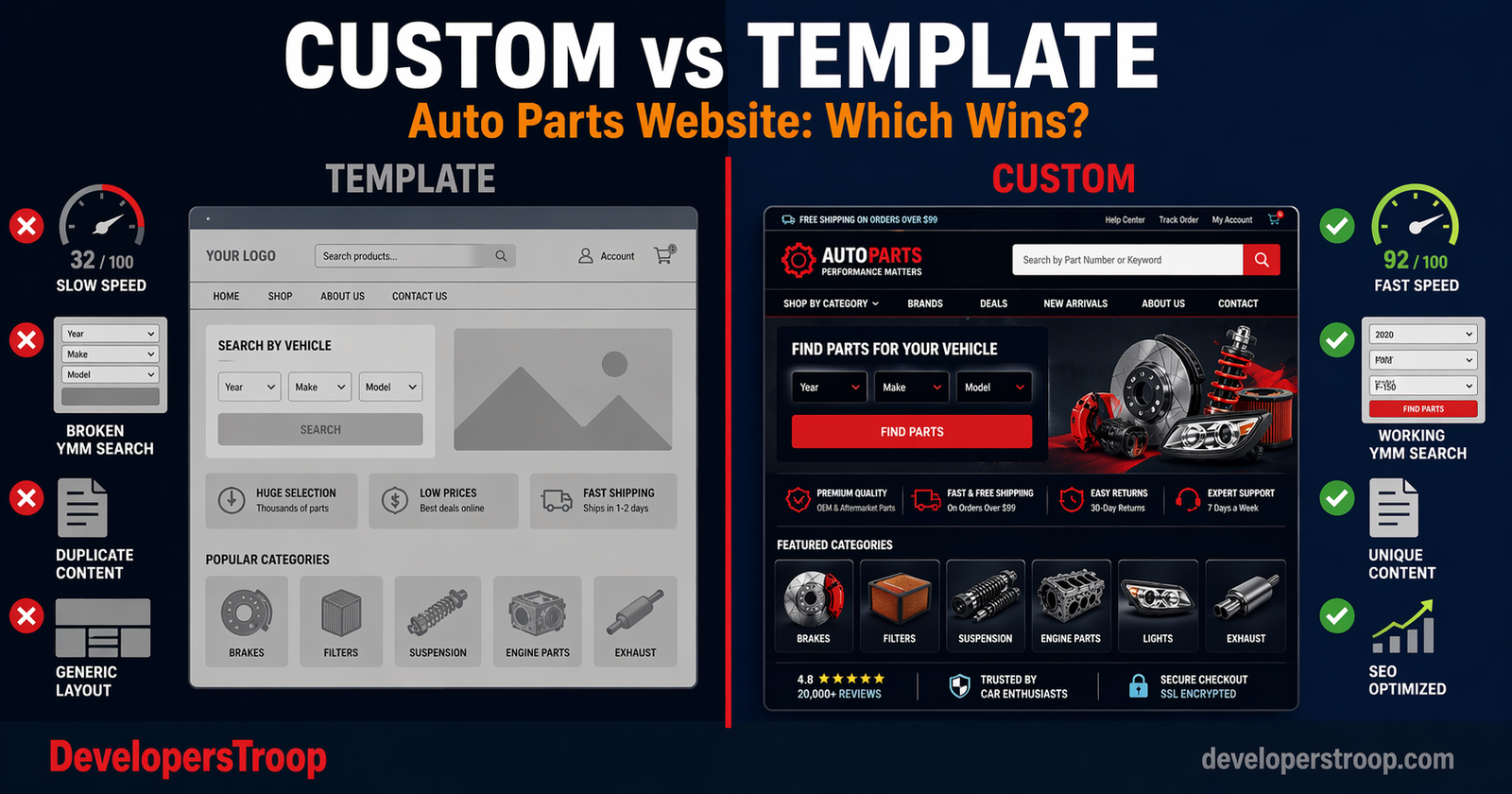
When you decide to build an auto parts store online, one of the very first decisions you face is also one of the most consequential: do you go with a pre-built template, or do you invest in a custom-built website?
It sounds simple. Templates are cheaper and faster. Custom is more expensive and takes longer. Case closed, right?
Not even close.
The reality is that the wrong choice here doesn’t just affect how your website looks – it determines whether your store can handle YMM fitment search, whether Google can properly index your catalog, whether your checkout converts on mobile, and ultimately whether your business grows or stalls.
We’ve built over 670 websites at DevelopersTroop, including hundreds of auto parts and wheel & tire ecommerce stores. We’ve seen both approaches succeed and fail. In this guide, we give you the complete, honest comparison so you can make the right decision for your specific situation.
What Is a Template Auto Parts Website?
A template website is built on a pre-designed theme or layout – purchased from a marketplace like ThemeForest, TemplateMonster, or directly from platforms like Shopify’s theme store.
You install the theme, add your logo, upload your products, and you have a working store. The design, layout, and core functionality are pre-built. You customize colors, fonts, and content – but the underlying structure is fixed.
Common template sources for auto parts stores:
- Shopify themes (Turbo, Ella, Empire)
- WooCommerce themes (Flatsome, Autokits, CarDealership)
- PrestaShop auto parts themes
- OpenCart automotive themes
Typical cost: $50 to $300 for the theme itself, plus developer time for setup and customization ($500 to $2,000 total for a basic launch)
Typical timeline: 1 to 4 weeks from purchase to live store
What Is a Custom Auto Parts Website?
A custom website is designed and built from scratch – or built on a platform like WooCommerce or Shopify but with fully custom design, custom functionality, and purpose-built features specific to your business requirements.
Nothing is borrowed from a template. Every element – the layout, the YMM search logic, the catalog architecture, the checkout flow, the product filtering system – is engineered specifically for your store.
What custom development includes:
- Original UI/UX design created for your brand and audience
- Custom YMM fitment search built to your catalog’s specific requirements
- Custom ACES/PIES data integration architecture
- Purpose-built catalog filtering and search functionality
- Custom checkout flow optimized for your conversion goals
- Scalable backend architecture designed for your catalog size
Typical cost: $3,000 to $20,000+ depending on complexity, catalog size, and feature requirements
Typical timeline: 6 to 16 weeks from kickoff to live store
Head-to-Head Comparison: Every Factor That Matters
1. YMM Fitment Search
This is the most critical feature of any auto parts website – and it’s where templates fall apart fastest.
Template Website: Most auto parts themes include a basic Year Make Model dropdown widget. It looks functional on the surface. But dig deeper and the problems emerge quickly:
- Basic YMM widgets are built for demonstration, not for real catalogs with 10,000+ SKUs
- They often can’t handle complex fitment relationships (same part, multiple sub-model variants)
- Performance degrades badly as catalog size grows – slow dropdown loading frustrates users
- They rarely integrate properly with ACES data standards
- Customizing fitment logic beyond the theme’s built-in capability requires rebuilding it anyway
Custom Website: YMM search is engineered specifically for your catalog from day one:
- Built to handle your exact vehicle database – whether 500 vehicles or 500,000
- Full ACES data compatibility built into the core architecture
- Lightning-fast performance regardless of catalog size
- Handles every fitment edge case: sub-models, engine variants, trim-level differences
- Can be extended – add tire size search, bolt pattern search, or universal part filtering without rebuilding
Winner: Custom – for any serious auto parts store, YMM is too important to compromise on.
2. Design & Brand Identity
Template Website: Templates are designed to look good in demos. In the real world, every store using the same theme looks nearly identical. Your competitors may be running the exact same Shopify theme with different colors and a different logo.
- Limited differentiation from competitors
- Design decisions made for the average store, not your specific audience
- Customization has hard limits – you can change colors and fonts, but you can’t restructure the layout without breaking the theme
- Template designs often age quickly as design trends evolve
Custom Website: Your brand identity is built into every pixel:
- Unique design that reflects your brand, your niche, and your target customer
- Layout and UX decisions made specifically for how auto parts buyers navigate and purchase
- Unlimited design flexibility – if you can design it, it can be built
- Timeless because it’s built for your brand, not following a generic template trend
Winner: Custom – if brand differentiation and professional credibility matter to you.
3. SEO Performance
Template Website: This is where template websites create the most hidden long-term damage.
- Most themes generate bloated, poorly structured HTML that loads slowly – and slow sites rank lower
- Template URL structures are often not optimized for auto parts SEO
- Many themes generate duplicate content by default through tag pages, archive pages, and filtered navigation URLs
- Schema markup is usually missing entirely or implemented incorrectly
- You’re sharing the same code base as thousands of other stores – Google sees patterns and penalizes thin, templated sites
Custom Website: SEO is built into the architecture from the start:
- Clean, lean code that loads fast – a direct ranking factor
- URL structures designed specifically around your keyword strategy
- Canonical tags and crawl control implemented correctly from day one
- Complete schema markup – Product, AutoPartsCompatibility, BreadcrumbList, FAQPage – all properly implemented
- No duplicate content issues from faceted navigation
- Site architecture designed to pass SEO authority from content pages to product pages efficiently
Our SEO services deliver dramatically better results when paired with a properly built custom foundation – because the technical groundwork is already clean.
Winner: Custom – the SEO ceiling on template websites is genuinely low for competitive auto parts keywords.
4. Performance & Speed
Template Website: Templates are built to work for everyone – which means they’re optimized for no one in particular.
- Themes include features and code for dozens of use cases your store doesn’t need – all of it adds weight
- Auto parts stores with large catalogs push template performance to its limit quickly
- Page speed scores of 40–60 on mobile are common with unoptimized templates
- Every plugin you add to extend template functionality adds more load time
Custom Website: Built lean with only what your store specifically needs:
- No bloat – only the code required for your exact feature set is included
- Optimized database queries designed for your catalog architecture
- Built-in CDN integration and image optimization from the start
- Consistently achieves PageSpeed scores of 85–95+ on both mobile and desktop
- Performance scales with your catalog growth because the architecture was designed for it
Winner: Custom – especially for stores with large catalogs where performance directly impacts conversion rate.
5. Catalog Management & Scalability
Template Website: Templates work reasonably well for small catalogs. As you scale, limitations become painful:
- Most themes struggle visibly with catalogs above 5,000 SKUs
- Adding new filtering attributes (engine size, drive type, trim level) requires theme modification or plugins
- Bulk import processes are constrained by the theme’s built-in tools
- Inventory sync from supplier feeds is often a plugin patchwork that breaks under load
- Scaling from 1,000 to 50,000 SKUs frequently requires rebuilding the site anyway
Custom Website: Catalog architecture is designed around your growth plan:
- Built to handle millions of SKUs without performance degradation
- Custom attribute and filtering systems that match your specific catalog structure
- Automated supplier data feed integration built into the core
- Bulk import and catalog management tools built specifically for your workflow
- Adding new vehicle databases, product lines, or catalog sources is straightforward because the architecture anticipated growth
Winner: Custom – if you plan to scale your catalog seriously, templates will become a bottleneck.
6. Conversion Rate Optimization
Template Website: Templates are designed to convert the average ecommerce buyer. Auto parts buyers are not average ecommerce buyers.
- Generic checkout flows not optimized for high-consideration auto parts purchases
- Limited ability to add fitment confirmation steps before checkout
- Trust signals are where the theme designer put them – not where your specific customers need them
- A/B testing and checkout optimization are constrained by what the theme allows
Custom Website: Every conversion touchpoint is designed for the auto parts buyer specifically:
- Fitment confirmation built into the add-to-cart and checkout flow
- Trust signals placed exactly where customer research shows they reduce purchase hesitation
- Custom upsell and cross-sell logic for related parts and kits
- Complete freedom to A/B test any element of the purchase flow
- Checkout optimized for both one-time buyers and returning trade customers
Winner: Custom – conversion rate differences of 1–3% translate to enormous revenue differences at scale.
7. Cost & Time to Launch
This is where templates have their genuine, undeniable advantage.
Template Website:
- Lower upfront investment – $500 to $3,000 total for a launched store
- Faster to market – live in 1 to 4 weeks
- Lower risk for testing a new business concept before committing full investment
- Many good-looking starting points available immediately
Custom Website:
- Higher upfront investment – $3,000 to $20,000+ depending on scope
- Longer build timeline – 6 to 16 weeks
- Requires a more detailed planning and briefing process upfront
- Higher initial commitment before you’ve validated your market
Winner: Template – for budget and speed to launch, templates win clearly.
8. Long-Term Total Cost of Ownership
Here’s where the calculation often flips – and most store owners don’t think about this until it’s too late.
Template Website:
- Every limitation you hit requires a plugin – and plugins cost money monthly
- Performance problems require expensive optimization work on top of a flawed foundation
- Many stores outgrow their template and pay to rebuild within 12 to 24 months
- The “cheap” template can end up costing more in total over 3 years than a custom build would have cost upfront
Custom Website:
- Higher upfront cost but no ongoing theme licensing fees
- Built to scale – you’re not rebuilding in 18 months because the catalog got too big
- Maintenance and updates are straightforward because the codebase is clean and documented
- Long-term SEO and conversion advantages compound in dollar value over time
Winner: Custom – when you calculate total 3-year cost of ownership including rebuilds, plugins, and lost revenue from poor performance, custom frequently wins.
The Complete Comparison Table
| Factor | Template Website | Custom Website |
| YMM Fitment Search | Basic, limited scalability | Purpose-built, fully scalable |
| Design Uniqueness | Generic, shared with competitors | 100% unique to your brand |
| SEO Performance | Limited, often problematic | Optimized from foundation up |
| Page Speed | Often poor (40–60 score) | Consistently high (85–95+) |
| Catalog Scalability | Struggles above 5,000 SKUs | Built for millions of SKUs |
| Conversion Optimization | Generic checkout flow | Purpose-built for auto parts buyers |
| Upfront Cost | $500 – $3,000 | $3,000 – $20,000+ |
| Time to Launch | 1 – 4 weeks | 6 – 16 weeks |
| Long-Term Cost | Higher (plugins + rebuilds) | Lower (built to last) |
| ACES/PIES Integration | Plugin-dependent, unreliable | Built into core architecture |
| Mobile Performance | Variable | Consistently optimized |
| Competitive Differentiation | Low | High |
So Which One Should You Choose?
The honest answer is: it depends on where you are in your business journey.
Choose a Template Website If:
- You are validating a new business idea and want to test the market before committing significant capital
- Your catalog is under 2,000 SKUs and you don’t anticipate major growth in the near term
- Your budget is genuinely limited and you need to launch with minimal upfront investment
- You are selling simple, universal parts that don’t require complex fitment logic
- You need to be live within weeks for a time-sensitive opportunity
A well-configured Shopify or WooCommerce store on a quality theme can absolutely generate real revenue – especially in the early stages. There’s no shame in starting with a template if it gets you to market and generating cash flow.
Choose a Custom Website If:
- You are serious about building a long-term, scalable auto parts business
- Your catalog exceeds 5,000 SKUs or will grow there within 12 months
- You sell wheels, tires, or complex fitment parts where YMM search is central to the customer experience
- You are competing against established players and need every SEO and conversion advantage available
- You have been on a template and are experiencing the limitations firsthand – slow performance, fitment issues, poor SEO rankings
- You want a website that is a genuine competitive asset, not just a functional storefront
At DevelopersTroop, we specialize in building custom auto parts ecommerce websites that are engineered specifically for this industry – with proper YMM search, ACES/PIES integration, SEO-optimized architecture, and catalog systems built to scale. We’ve seen what template limitations cost businesses in lost sales and expensive rebuilds – and we build custom from the start so our clients never face that problem.
Pro Tip from DevelopersTroop: If your budget is tight but you know you need custom eventually, consider a phased approach – launch on a carefully chosen Shopify theme to generate initial revenue, then invest that revenue into a custom build within 12 to 18 months. This is smarter than staying on a template permanently OR delaying launch indefinitely waiting for the perfect custom build budget.
Real Cost of Getting This Wrong
Let’s talk about what the wrong choice actually costs – because most people underestimate this number.
Scenario A: Template first, rebuild later
- Template setup: $2,000
- 12 months of plugins to patch fitment gaps: $1,200/year
- SEO cleanup after duplicate content damage: $3,000
- Custom rebuild after outgrowing template: $8,000
- Total: $14,200 – plus 12 months of lost revenue from poor rankings and conversion rate
Scenario B: Custom from the start
- Custom build investment: $8,000
- No plugin patchwork needed
- Clean SEO foundation from day one
- No rebuild required as catalog scales
- Total: $8,000 – plus faster ranking growth and higher conversion rate from month one
The math on custom is often better than it first appears – especially when you account for lost revenue during the period your template site underperforms
Conclusion
Template websites are not bad. For the right situation – early stage, limited catalog, tight budget – they are the smart starting point. There’s genuine value in getting to market quickly and learning from real customers.
But for any auto parts business serious about long-term growth, a custom-built website is not a luxury. It is a competitive necessity.
The stores dominating Google search results for auto parts keywords, converting at 2–3% rather than 0.5%, and scaling their catalogs to tens of thousands of SKUs without performance issues – they are almost universally running custom-built platforms built by specialists who understand this industry.
You don’t have to choose between starting fast and building right. You have to choose the right time to make the transition – and understand clearly what staying on a template is costing you every month you wait.
Ready to build your auto parts store the right way? DevelopersTroop specializes in custom auto parts ecommerce website development – from YMM fitment search and ACES/PIES integration to full SEO-optimized architecture. We build stores that are engineered to rank, convert, and scale.
Frequently Asked Questions
Question:Is a custom auto parts website worth the cost?
AnswerFor auto parts stores with serious growth ambitions, yes – overwhelmingly. The upfront cost of a custom build is typically recovered within 6 to 12 months through better conversion rates, faster SEO ranking, and avoiding the plugin costs and rebuild expenses that template sites inevitably generate. The long-term ROI of a custom auto parts website built correctly from the start almost always exceeds that of a cheaper template approach.
Question:Can a template website handle YMM search properly?
AnswerBasic template YMM widgets work for small demonstrations but consistently struggle with real auto parts catalogs at scale. They typically can’t handle complex fitment relationships, perform poorly with large vehicle databases, and rarely integrate properly with ACES data standards. For stores where fitment accuracy is critical – especially wheels, tires, and specific OEM parts – custom YMM search is strongly recommended.
Question:How long does a custom auto parts website take to build?
AnswerA professional custom auto parts ecommerce website typically takes 6 to 16 weeks depending on catalog size, feature complexity, and the number of integrations required. Simple custom builds on Shopify or WooCommerce with standard features can launch in 6 to 8 weeks. Large custom platforms with full ACES/PIES integration, custom YMM logic, and complex catalog architecture take 12 to 16 weeks. DevelopersTroop provides a detailed timeline during the free consultation phase.
Question:What platform is best for a custom auto parts website?
AnswerWooCommerce is best for stores prioritizing SEO flexibility and deep customization. Shopify is best for stores prioritizing ease of management and scalability with less technical overhead. Fully custom development (Laravel, custom PHP, or headless commerce) is best for enterprise-scale operations with unique requirements that off-the-shelf platforms can’t accommodate. DevelopersTroop builds on all three and recommends the right platform after understanding your specific business requirements.
Question:Can I start with a template and upgrade to custom later?
AnswerYes – and for many businesses this is the smartest approach. Launch on a well-configured Shopify or WooCommerce theme to generate initial revenue and validate your market. Then invest that revenue into a proper custom build once you have proof of concept and a clearer picture of your technical requirements. DevelopersTroop has migrated dozens of auto parts stores from templates to custom platforms – we know exactly how to preserve your SEO rankings and catalog data during the transition.