


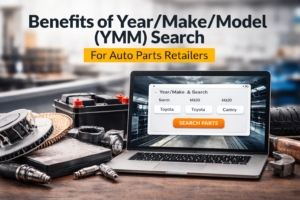
Year/Make/Model (YMM) search helps auto parts retailers improve customer experience by showing only vehicle-compatible products. This reduces returns, increases conversions, and boosts SEO by targeting high-intent, vehicle-specific searches.
Imagine you’re standing in your garage on a Saturday morning. You have your tools laid out, the hood of your Ford F-150 is popped open, and you’re ready to swap out your brake pads. You ordered them online three days ago, feeling confident. But as you pull the new pads out of the box, you realize they’re about an inch too short. They don’t fit.
This is the nightmare of every DIY car owner and the most expensive headache for every auto parts retailer. In the world of automotive e-commerce, “close enough” is never good enough. If you sell parts for a Toyota Camry, a Chevrolet Silverado, or a Tesla Model 3, you aren’t just selling a product. You’re selling a promise that the part will actually work for that specific vehicle.
This is where Year/Make/Model (YMM) search comes in. It’s the bridge between a frustrated customer and a successful sale. We at Developers Troop have spent years watching the automotive market evolve, and in 2026, a high-performing YMM search isn’t just a “nice feature” anymore. It’s the heartbeat of your store.
Why Accuracy Is Everything in Auto Parts E-Commerce
The automotive industry is unique because of the sheer volume of data involved. A single car model can have hundreds of different variations based on the trim level, engine size, or even the month it was manufactured.
The Cost of a “Wrong Part” Return
When a customer buys the wrong part, everyone loses. The customer is frustrated because their project is stalled. You, the retailer, lose money on shipping costs both ways. In 2026, return rates for auto parts stores without advanced fitment data can hover around 25%. That’s a massive drain on your profits. By implementing a robust YMM (Year/Make/Model) search for autoparts, you can slash those return rates to less than 5%.
Building Trust with Your Audience
Trust is a currency in the automotive world. If a customer uses your search tool and it tells them a specific part fits their BMW 3 Series, they’re putting their safety in your hands. When that part fits perfectly, you win a customer for life. If it fails, they will never return. A well-designed YMM search is a trust signal that tells your visitors you’re a professional who understands their vehicle.
How YMM Search Transforms the Customer Journey
Let’s look at this from the perspective of your customer. Most people coming to your site aren’t “car experts.” They’re people looking to fix a problem.
Ending Choice Paralysis
If a user searches for “oil filter,” and your site shows 4,000 results, they will leave. It’s too much information. But if the first thing they see is a dropdown menu asking for their 2022 Honda Civic details, and then they only see the four filters that actually work for their car, the decision becomes easy. This is the core of Conversion Rate Optimization (CRO).
The “Garage” Feature: Saving Vehicle Profiles
In 2026, the best retailers allow customers to save their “Garage.” If I own a Jeep Wrangler and a Subaru Outback, I should be able to save both profiles on your site. The next time I visit, the site already knows who I am and what I need. This level of personalization makes your store feel like a local, friendly shop rather than a cold, corporate machine.
The Technical Backbone: Understanding Fitment Data
You might be wondering how all this data stays organized. It isn’t magic. It’s based on industry standards that every serious retailer needs to know.
ACES and PIES: The Industry Gold Standards
To make YMM work, we use two critical data standards:
- ACES (Aftermarket Catalog Exchange Standard): This handles the “vehicle” part. It tells the system that a part fits a 2018-2023 Ford Mustang.
- PIES (Product Information Exchange Standard): This handles the “product” part. It includes the weight, the brand name, the material, and the price.
When these two work together, your website becomes a high-performance engine. If you’re looking for a cheap website design that still incorporates these complex standards, you have to be careful. Many low-cost builders can’t handle the massive databases required for auto parts. You need a partner who understands how to map these data points without slowing down your site speed.
SEO and AEO: Why YMM Is Your Best Marketing Tool
Search engines have changed. In 2026, people won’t just search for “car parts.” They search for “spark plugs for 2015 Dodge Ram 1500 5.7L.” This is a “high-intent” long-tail keyword.
Ranking for Answer Engines
Answer Engine Optimization (AEO) is about providing the direct answer to a specific question. When Google or an AI assistant looks for an answer to “What is the best battery for a 2019 Nissan Altima?”, it looks for sites that have clear, structured fitment data. A YMM search creates thousands of these specific landing pages automatically, helping you dominate the search results for specific vehicle niches.
Geographic Entities and Local SEO
If you have a physical shop in Los Angeles, Chicago, or Miami, your YMM search can help with local SEO. When someone in your city searches for “Toyota brake pads near me,” a site that clearly shows fitments for that Toyota is much more likely to show up in the “Map Pack.”
Boosting Sales with Wheels and Tires
If your store sells wheels and tires, YMM search isn’t just a benefit. It is mandatory. Wheel fitment is incredibly complex. You have to worry about bolt patterns, offset, and center bores.
The Complexity of Bolt Patterns
A Chevrolet Silverado uses a different bolt pattern than a Ford F-150. If you sell a customer a set of beautiful 20-inch rims that don’t fit their hubs, you have a shipping nightmare on your hands. A custom YMM tool can filter out every wheel that won’t bolt up to their specific vehicle, ensuring a 100% success rate on every order.
Tire Sizing and Speed Ratings
Tire search is often the first interaction a customer has with an auto parts site. By allowing them to search by their vehicle, you can show them exactly which tire sizes are recommended by the manufacturer. This prevents the liability of selling a tire with a speed rating that is too low for a high-performance vehicle like a Porsche 911.
Mobile Optimization: The Modern Mechanic
Most people are searching for parts while they are actually looking at their car. They are on their phones, likely with greasy hands.
Designing for a Mobile World
Your YMM dropdowns need to be big, easy to click, and lightning fast. If the search takes ten seconds to load on a 5G connection, the customer will go to eBay Motors or Amazon instead. We focus on “lean” code that ensures your search tool works perfectly on a six-inch screen.
The Developers Troop Approach to YMM Integration
We don’t believe in one-size-fits-all solutions. Every auto parts retailer has a different inventory and a different target audience.
Custom vs. Off-the-Shelf Search
While there are plugins for Shopify and WooCommerce that claim to do YMM, they often struggle when your inventory grows past a few hundred items. If you have 50,000 SKUs, you need a custom-built solution that doesn’t crash your server. Our team specializes in building “headless” search architectures that are incredibly fast and scalable.
Data Accuracy and Regular Updates
Car manufacturers release new models every year. Your YMM search needs to stay updated. We build systems that can automatically pull in new fitment data from providers like SEMA Data or Opticat, so you never have to worry about your site becoming obsolete.
Benefits Beyond the Sale: Data and Analytics
One of the most overlooked benefits of YMM search is the data it gives you as a business owner.
Knowing What to Stock
If your search logs show that 500 people searched for “2024 Tesla Model Y floor mats” but you don’t carry them, you have just found your next big profit opportunity. Your YMM tool acts as a “demand sensor” for your market.
Better Inventory Management
By seeing which vehicles are the most popular on your site, you can optimize your warehouse space. Why keep 50 sets of brake pads for a 1995 Pontiac Sunfire if everyone visiting your site owns a modern Jeep?
Overcoming the Challenges of YMM Implementation
We know it sounds daunting. Mapping millions of rows of data is a big task. But it’s one we tackle every day.
Many retailers come to us with a “messy” database. Descriptions are inconsistent, and part numbers are missing. We help you clean and standardize your data before we build the search tool. This ensures that the engine we build for you is running on high-octane fuel.
We also understand that you have a budget. That’s why we offer a range of solutions, from cost-effective cheap website design that includes basic YMM, to high-end, custom enterprise solutions for national distributors.
Industry Regulations and Compliance
In 2026, the automotive aftermarket is subject to more regulations than ever.
Safety Standards
Selling the wrong part for a steering or braking system isn’t just a business mistake. It’s a safety risk. By using YMM search, you ensure that you are only selling parts that meet the original equipment (OE) specifications for that vehicle. This protects you from liability and ensures your customers stay safe on the road.
Environmental Regulations
In states like California, certain parts (like catalytic converters) must meet specific “CARB” (California Air Resources Board) standards. A smart YMM search can use the customer’s location to show only the parts that are legal in their specific state.
Future Trends: AI-Powered Fitment
As we look further into 2026 and beyond, YMM is evolving.
Voice-Activated Search
“Hey, find me an alternator for my 2012 Chevy Tahoe.” This is how people will search in the near future. Your YMM data structure is what will allow AI assistants to answer that question correctly.
Visual Search: Snap a Photo, Find a Part
We’re already working on tools that allow a customer to take a photo of a part on their car. The AI identifies the part and then uses the vehicle’s YMM data to confirm the exact fitment.
Conclusion: Don’t Let Your Customers Guess
The automotive world is getting more complex, not less. With the rise of electric vehicles and more advanced safety tech, the “universal part” is a thing of the past. If you want to survive as an auto parts retailer in 2026, you must give your customers the confidence to buy.
A Year/Make/Model search is the best investment you can make in your e-commerce store. It increases your sales, builds your reputation, and saves you a fortune in returns. But don’t settle for a tool that just “works.” Build a tool that wins.
At Developers Troop, we’re ready to help you take the guesswork out of your store. Whether you need a full YMM (Year/Make/Model) search for autoparts or a fresh, high-performance cheap website design, we have the expertise to get you to the finish line. Ready to supercharge your auto parts store? Contact Developers Troop today and let’s build something that fits.
Frequently Asked Questions (FAQs)
1. Why is YMM search better than a regular search bar?
A regular search bar often returns irrelevant results. A YMM search uses “fitment logic” to filter out everything that won’t work for a specific vehicle, which reduces customer frustration and returns.
2. Can I add YMM search to my existing Shopify or WooCommerce site?
Yes! While it is a complex integration, we can add YMM functionality to most major e-commerce platforms. However, custom builds often provide much better speed and data handling.
3. What is the difference between ACES and PIES?
ACES focuses on the vehicle (what the part fits), while PIES focuses on the product (what the part is, how much it weighs, and what it’s made of). Both are needed for a professional auto parts store.
4. How do I get fitment data for my products?
You can get fitment data from manufacturers, specialized data providers like SEMA Data, or by hiring a team like ours to help you map and organize your existing inventory.
5. Does YMM search help with SEO?
Absolutely. It creates highly specific landing pages for long-tail keywords (like “2020 Ford F-150 headlight bulb”), which are easier to rank for and have much higher conversion rates.