


Did you know that over 80% of auto parts buyers start their search online – yet most auto parts ecommerce websites convert less than 1% of their visitors into buyers?
The online auto parts industry is worth over $100 billion globally, and it’s growing every year. But here’s the hard truth: having a website is not enough. Most auto parts store owners invest money building a site, only to watch it sit there collecting dust while competitors steal their customers.
The problem isn’t the product. It’s the website.
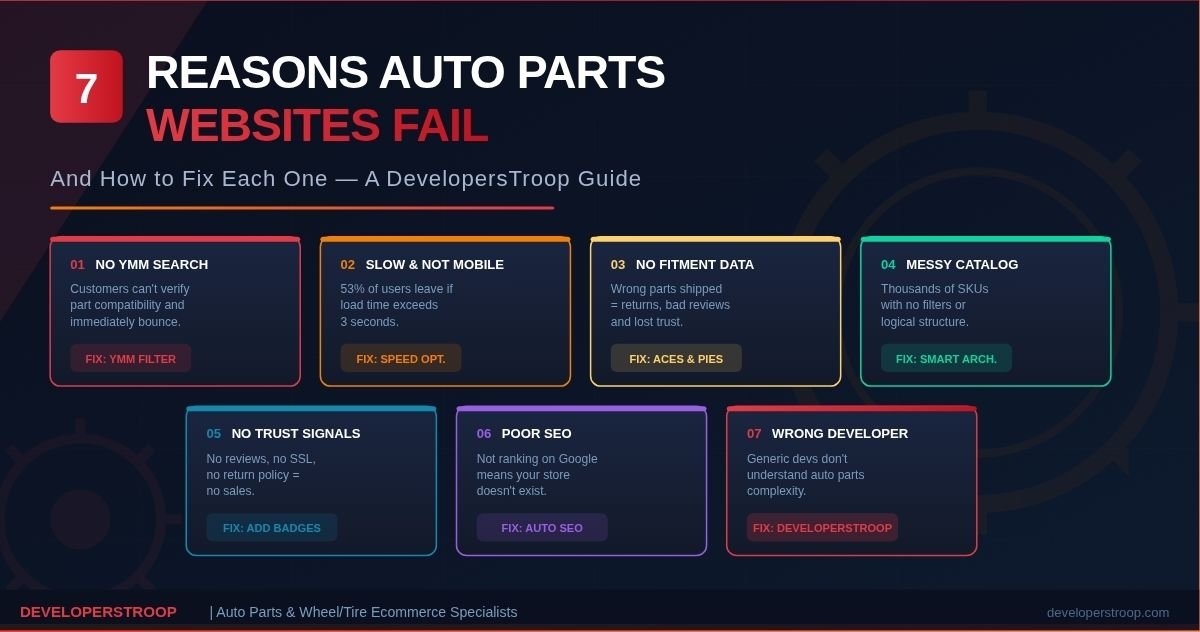
In this guide, we reveal the 7 most common reasons auto parts websites fail – and exactly how to fix each one so your store can start generating real, consistent sales online.
Reason #1: No YMM (Year Make Model) Search Filter
This is the single biggest killer of auto parts ecommerce websites – and it’s completely avoidable.
When a customer lands on your store, the first thing they need to know is: “Does this part fit MY vehicle?” If they can’t answer that question in seconds, they leave. They don’t browse. They don’t contact you. They just go to a competitor who makes it easy.
Auto parts are not like clothing or electronics. A brake pad for a 2018 Toyota Camry is completely different from one for a 2018 Honda Civic. Without a Year Make Model (YMM) search filter, customers are forced to guess – and they won’t.
Real-world consequence: Your bounce rate skyrockets, your conversion rate tanks, and customers go straight to RockAuto or Amazon where fitment search is built in.
How to Fix It
Integrate a proper YMM fitment search on your homepage and product pages. This allows shoppers to select their vehicle year, make, and model upfront – and your catalog instantly filters to show only compatible parts.
Our team at DevelopersTroop has built advanced YMM Year Make Model search systems specifically for auto parts and wheel & tire stores. It’s one of the most impactful features you can add to your store – and we make it seamless.
Reason #2: Poor Website Speed & Mobile Experience
Here’s a stat that should shake every store owner: 53% of mobile users abandon a website that takes more than 3 seconds to load. In auto parts ecommerce, where catalogs contain thousands of products and high-resolution images, slow loading is extremely common.
On top of speed, more than 60% of online shopping now happens on mobile devices. If your website isn’t perfectly optimized for smartphones – with easy navigation, tap-friendly buttons, and fast load times – you’re losing the majority of your potential buyers before they even see your products.
A slow, clunky mobile experience signals to customers (and Google) that your store isn’t professional. That destroys both conversions and rankings.
How to Fix It
- Compress and lazy-load images across your product catalog
- Use a Content Delivery Network (CDN) to serve your site faster globally
- Implement responsive web design so every page adapts perfectly to any screen size
- Minimize unnecessary plugins and scripts that slow down load time
- Aim for a Google PageSpeed score of 85+ on both mobile and desktop
When we build auto parts ecommerce websites, speed and mobile optimization are built into the foundation – not added as an afterthought.
Reason #3: No Fitment or Compatibility Data (ACES & PIES)
This one costs auto parts businesses thousands of dollars in returns, bad reviews, and lost customer trust.
ACES (Aftermarket Catalog Exchange Standard) and PIES (Product Information Exchange Standard) are the industry-standard data formats that link your products to specific vehicle applications. Without this data properly integrated into your store, customers order parts that don’t fit – and then blame you for it.
Wrong parts shipped means:
- Expensive return shipping costs
- Negative reviews on Google and Trustpilot
- Customers who never come back
- Damage to your brand reputation
Many generic web developers don’t even know what ACES/PIES data is. They build a beautiful-looking store with zero fitment intelligence underneath.
How to Fix It
Work with a developer who understands auto parts fitment data integration at a technical level. Your product database needs to be mapped against a proper vehicle fitment database (such as AutoCare or TecDoc). Every product listing should clearly display compatible vehicles, and the backend should prevent incompatible parts from appearing in search results for a given vehicle.
This is a specialized skill – and it’s one of our core strengths at DevelopersTroop.
Reason #4: Weak or Confusing Product Catalog Structure
Auto parts stores typically carry tens of thousands of SKUs across hundreds of categories. Without a smart, logical catalog structure, your store becomes a maze that frustrates customers and search engines alike.
Common catalog mistakes include:
- No subcategories (e.g., dumping all braking parts under one “Brakes” category)
- No filtering options by brand, price, vehicle type, or part condition
- Duplicate product listings with slightly different names
- Missing product attributes like part numbers, OEM references, and specifications
- No search functionality within the catalog
When customers can’t find what they need in under 30 seconds, they leave. When Google’s crawlers can’t understand your site structure, you don’t rank.
How to Fix It
Build your catalog with smart category architecture from day one:
- Create clear parent and child categories (e.g., Brakes → Brake Pads → Ceramic Brake Pads)
- Add powerful attribute-based filters: brand, vehicle compatibility, price range, condition
- Implement an intelligent site search with autocomplete and part number lookup
- Ensure every product page has complete specs, part numbers, high-quality images, and fitment notes
A well-structured catalog doesn’t just improve user experience – it dramatically improves your SEO rankings for product-level keywords.
Reason #5: No Trust Signals or Social Proof
Think about it from the buyer’s perspective: they’re about to spend $200 on brake calipers from a website they’ve never heard of. Why should they trust you?
The auto parts market has a serious trust problem. Counterfeit parts, wrong fitment, delayed shipping – buyers have been burned before. If your website doesn’t immediately communicate credibility and reliability, they will choose a brand they already know.
Missing trust signals include:
- No customer reviews or star ratings on product pages
- No SSL certificate (no padlock in the browser = instant red flag)
- No visible return policy or warranty information
- No contact information or live chat
- No recognizable payment badges (Visa, PayPal, Stripe, etc.)
How to Fix It
Build trust into every layer of your website:
- Display verified customer reviews on product pages and your homepage
- Show trust badges: SSL Secure, Money-Back Guarantee, Free Returns
- Make your return policy and shipping times crystal clear – before checkout
- Add a live chat widget or WhatsApp button so customers know a real team is behind the store
- Show your phone number and address in the header – transparency builds confidence
These are not design extras. They are conversion essentials.
Reason #6: Poor SEO – Not Ranking on Google
You could have the best auto parts website in the world, but if it doesn’t show up on Google, it doesn’t exist.
Most auto parts store owners either ignore SEO completely or rely on generic tactics that don’t work for this niche. Auto parts SEO requires a very specific approach because of the complex relationship between products, vehicles, and search intent.
Common SEO failures in auto parts stores:
- No schema markup for auto parts (Google can’t understand your products)
- Thin product descriptions copied directly from manufacturer specs
- No blog or content strategy to capture informational search traffic
- Duplicate content across thousands of similar product pages
- Missing local SEO for stores that also serve local customers
Real-world consequence: Your competitor who invested in SEO is ranking #1 for “brake pads for 2019 Ford F-150” and capturing buyers who are ready to purchase – while your store gets zero organic traffic.
How to Fix It
- Implement automotive schema markup so Google correctly indexes your parts, fitment data, and pricing
- Write unique, keyword-rich product descriptions that go beyond generic manufacturer text
- Build a content strategy with blogs targeting buyer-intent keywords (like this one!)
- Fix technical SEO: site speed, mobile optimization, proper URL structures, XML sitemaps
- Run a local SEO campaign if you serve customers in specific regions
Our SEO services are specifically designed to help ecommerce businesses grow their organic traffic and sales month over month.
Reason #7: Choosing the Wrong Platform or Developer
This is perhaps the most expensive mistake – and unfortunately, it’s the hardest to recover from.
Many auto parts store owners hire a generic web developer who has built restaurant websites, portfolio pages, and blogs – but has never dealt with a 50,000-SKU auto parts catalog, YMM search integration, fitment data, or ACES/PIES compatibility.
The result? A website that looks okay on the surface but is fundamentally broken underneath. No fitment logic. No proper catalog structure. No SEO foundation. And when something goes wrong – and it will – the developer has no idea how to fix it.
Similarly, choosing the wrong platform (e.g., a basic Wix or Squarespace site for a large auto parts store) creates technical ceilings you’ll hit the moment you try to scale.
How to Fix It
Work with a development team that specializes in auto parts ecommerce – one that understands the industry’s unique technical requirements from day one.
At DevelopersTroop, we’ve built 670+ websites, with deep specialization in auto parts ecommerce website development. We work with WordPress/WooCommerce, Shopify, and custom solutions – and we know exactly how to build a store that handles large catalogs, YMM search, fitment data, and SEO out of the box.
Don’t rebuild your store from scratch in 12 months because you chose the wrong partner. Get it right the first time.
Auto Parts Websites: Fail vs. Succeed
| Feature | Failing Store | Successful Store |
| YMM Search | Not available | Fully integrated on homepage & product pages |
| Mobile Speed | Loads in 5–10 seconds | Loads in under 2 seconds |
| Fitment Data | No ACES/PIES integration | Full fitment compatibility data mapped |
| SEO | No schema, thin content | Automotive schema, rich content strategy |
| Trust Signals | No reviews, no badges | Reviews, SSL, return policy, payment badges |
| Catalog Structure | Flat, unfiltered, confusing | Smart categories, filters, part number search |
| Developer Experience | Generic developer | Auto parts ecommerce specialist |
Conclusion
The auto parts ecommerce market is booming – but only for stores that are built correctly. In 2026 and beyond, fixing these 7 issues isn’t optional. It’s the difference between a store that generates sales every day and one that quietly fails.
To recap, the 7 reasons auto parts websites fail are: missing YMM search, poor speed and mobile experience, no fitment data, a confusing product catalog, lack of trust signals, poor SEO, and choosing the wrong developer or platform.
Every single one of these problems is fixable – but only if you work with the right team.
Is your auto parts website making these mistakes? DevelopersTroop specializes in building high-converting auto parts and wheel & tire ecommerce websites, with full YMM search, fitment integration, and SEO built in from day one.
👉 Get a Free Consultation Today →
Frequently Asked Questions
Question: Why do auto parts websites have low conversion rates?
Most auto parts websites fail to convert because they lack essential features like YMM (Year Make Model) vehicle search, proper fitment data, and trust signals. Customers who can’t quickly verify that a part fits their vehicle will abandon the site immediately rather than risk buying the wrong product.
Question: What is YMM search and why is it important for auto parts stores?
Answer: YMM stands for Year Make Model. It’s a search filter that allows customers to enter their vehicle details and instantly see only compatible parts. Without it, customers have no reliable way to know if a product fits their car – making it the single most critical feature for any auto parts ecommerce website.
Question: Which platform is best for auto parts ecommerce?
Answer: The best platform depends on your catalog size and business needs. WooCommerce (WordPress) is excellent for flexibility and SEO. Shopify is great for ease of use and scalability. For large catalogs with complex fitment requirements, a custom-built solution may be the best option. DevelopersTroop builds on all three and recommends the right platform based on your specific goals.
Question: How do I increase sales on my auto parts website?
Answer: To increase sales, focus on: integrating YMM fitment search, improving site speed, adding customer reviews and trust badges, investing in SEO to drive organic traffic, and ensuring your product catalog is well-structured with complete fitment data. Each of these factors directly impacts conversion rate and customer confidence.
Question: How much does auto parts website development cost?
Answer: Auto parts ecommerce website development typically ranges from $1,500 to $15,000+ depending on catalog size, platform, required features (YMM search, fitment data integration, custom filters), and design complexity. DevelopersTroop offers competitive pricing with specialized expertise – contact us for a free quote tailored to your project.